
Leone Connect Podcast
Why Public Outrage So Often Fails to Produce Public Change
Anger can expose injustice. What turns it into lasting change?
This short companion insight explores the gap between public frustration and durable reform in Sierra Leone—and the role of everyday fairness, organized citizenship and sustained institutional pressure.
Written by Bhai-Dhawa Sesay. Listen to the original 6-minute-39-second recording and read the accompanying transcript below.
This is a free companion insight from The Five C Theory, not the complete audiobook.
Data saver delays audio loading. Transcript first keeps the written record available until you choose to load audio. Offline availability is managed by your browser or device.
Bookmarks
This browser keeps listening progress privately. If you enable signed-in synchronization, Leone Connect stores only your episode progress, queue and bookmarks. Anonymous plays and feature use contribute to aggregate publishing analytics; no visitor profile is created.
Show transcriptHide transcript
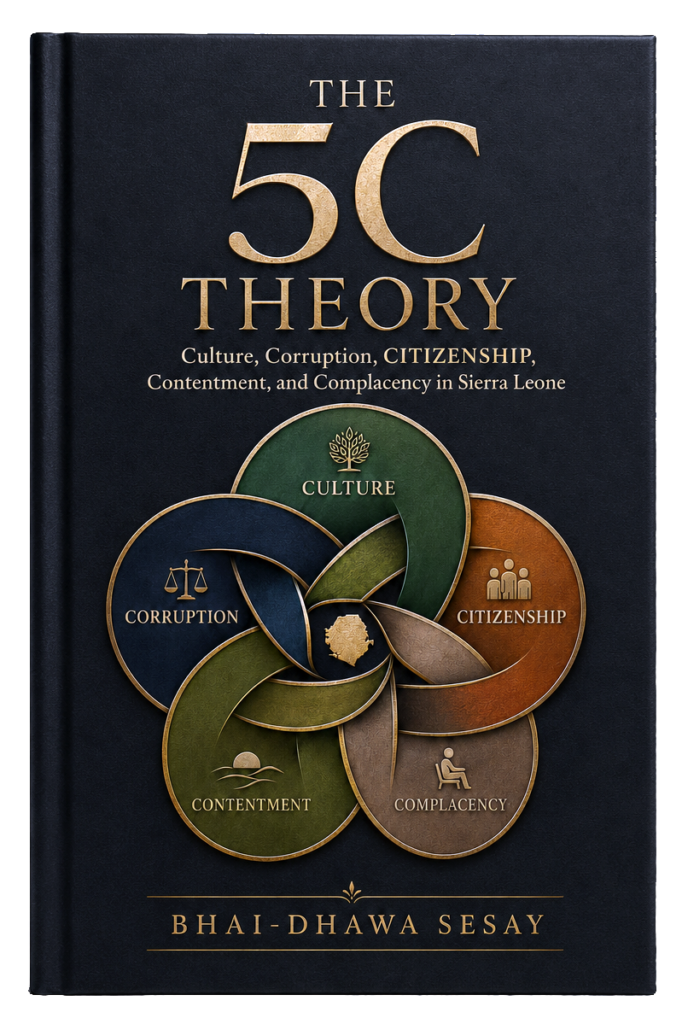
The 5 C Theory.
By Bhai Dhawa See Say!
An Insight from the book.
Why Public Outrage So Often Fails to Produce Public Change.
In Sierra Leone, public anger is often abundant while durable reform remains difficult. The problem is not a failure to notice injustice; it is the failure to convert complaint into consistent citizenship, organized pressure, and institutions that serve the public rather than private connections.
Central claim.
Public outrage produces little lasting change when it remains an emotional response rather than becoming ethical consistency, organized citizenship, sustained institutional pressure, and cultural expectations that place public duty above private access.
The gap between anger and change.
In Sierra Leone, public frustration is rarely difficult to find. Concerns about corruption, weak institutions, poor public services, political favoritism, unemployment, rising costs, and unequal opportunity circulate through homes, markets, offices, poda-podas, radio programmes, community meetings, and social-media conversations.
That public awareness matters. It shows that citizens can recognize when a service is failing, when access is unequal, or when public authority appears to serve private advantage. Yet recognition is not the same as reform. Anger may rise quickly, spread widely, and then disappear without altering the practices, incentives, or institutions that made the problem possible.
The central difficulty, then, is not simply that people are silent or uninformed. It is that outrage is often left in its most temporary form: a reaction. It may release frustration, expose a problem, or embarrass an official. But by itself it does not create records, build collective capacity, sustain attention, or establish a standard that applies even when wrongdoing benefits people close to us.
The Five C Theory offers a way to understand this gap. Culture, Corruption, Citizenship, Contentment, and Complacency are not presented as five separate defects with five easy remedies. They are interconnected forces. They can create a pattern in which people condemn public failure in principle while accommodating it in private practice. In that pattern, the system survives not only because of what powerful actors do, but also because of what ordinary citizens learn to expect, excuse, seek, or tolerate.
Culture: the unwritten rules behind public conduct.
Culture includes more than language, ceremony, food, dress, and tradition. It also includes the unwritten rules people use to understand authority, respect, loyalty, success, obligation, and belonging. These rules can provide moral strength. The essay identifies communal care, hospitality, resilience, responsibility to relatives, and collective responsibility as values that can support accountability and the public good.
But the same social world can produce a conflict between formal rules and informal expectations. A public institution may be expected to treat citizens equally, while an official may be pressured to give special access to relatives, associates, party members, or people from a shared region or network. When an official refuses such a request, that person may be seen as unhelpful. When an official grants it, the action may be praised as generosity.
This is not an argument that Sierra Leonean culture is inherently corrupt. The essay explicitly rejects that conclusion. Culture is not fixed as either good or bad; its values can be directed towards public responsibility or used to excuse conduct that harms it. The question is whether loyalty to a person may outweigh responsibility to the public.
That question is demanding because it reaches beyond the conduct of leaders. It asks citizens to notice when a request for help becomes a request for an unfair exception. It asks communities to honour integrity even when integrity denies someone preferential treatment. A culture of accountability cannot be built by condemning visible misconduct alone. It must also make fairness socially respectable when fairness is inconvenient.
Corruption as an alternative system of access.
Corruption is often pictured as a secret exchange of money. The essay asks readers to see a wider field: access, protection, employment, contracts, silence, influence, selective enforcement, and the expectation of future favours can also become forms of corrupt exchange. What joins these practices is not only money, but the conversion of public authority or public opportunity into private advantage.
When such exchanges become normal, corruption ceases to appear exceptional. It begins to function as an alternative system of administration. People may come to believe that official procedures are less reliable than a personal connection, and that a right is not truly available unless someone influential can help secure it.
Trust and accuracy
Corrections and current version
No verified corrections are recorded for this episode.