
Leone Connect Podcast
The Five C Theory — Private Audio Test
Welcome to Leone Connect Audio—where books, voices, and ideas come together. In this episode, we explore The Five C Theory by Bhai-Dhawa Sesay. Rooted in Sierra Leone. Connected to the world.
Let’s begin.
Data saver delays audio loading. Transcript first keeps the written record available until you choose to load audio. Offline availability is managed by your browser or device.
Bookmarks
This browser keeps listening progress privately. If you enable signed-in synchronization, Leone Connect stores only your episode progress, queue and bookmarks. Anonymous plays and feature use contribute to aggregate publishing analytics; no visitor profile is created.
Episode navigation
Chapters
Show transcriptHide transcript
Select up to 1,000 characters within a timed passage, or use Save passage below. Times mark the start of the passage. Private quotes use your bookmark synchronization setting; with it off, they stay on this device.
A country can know its problems by heart.
It can name them in homes and offices, on the radio, in parliament, in the marketplace, and across social media.
It can debate them, condemn them, and promise that things must change.
And still awaken to the same conditions.
The mystery is not whether people know what is wrong.
The deeper question is why knowing so often fails to become change.
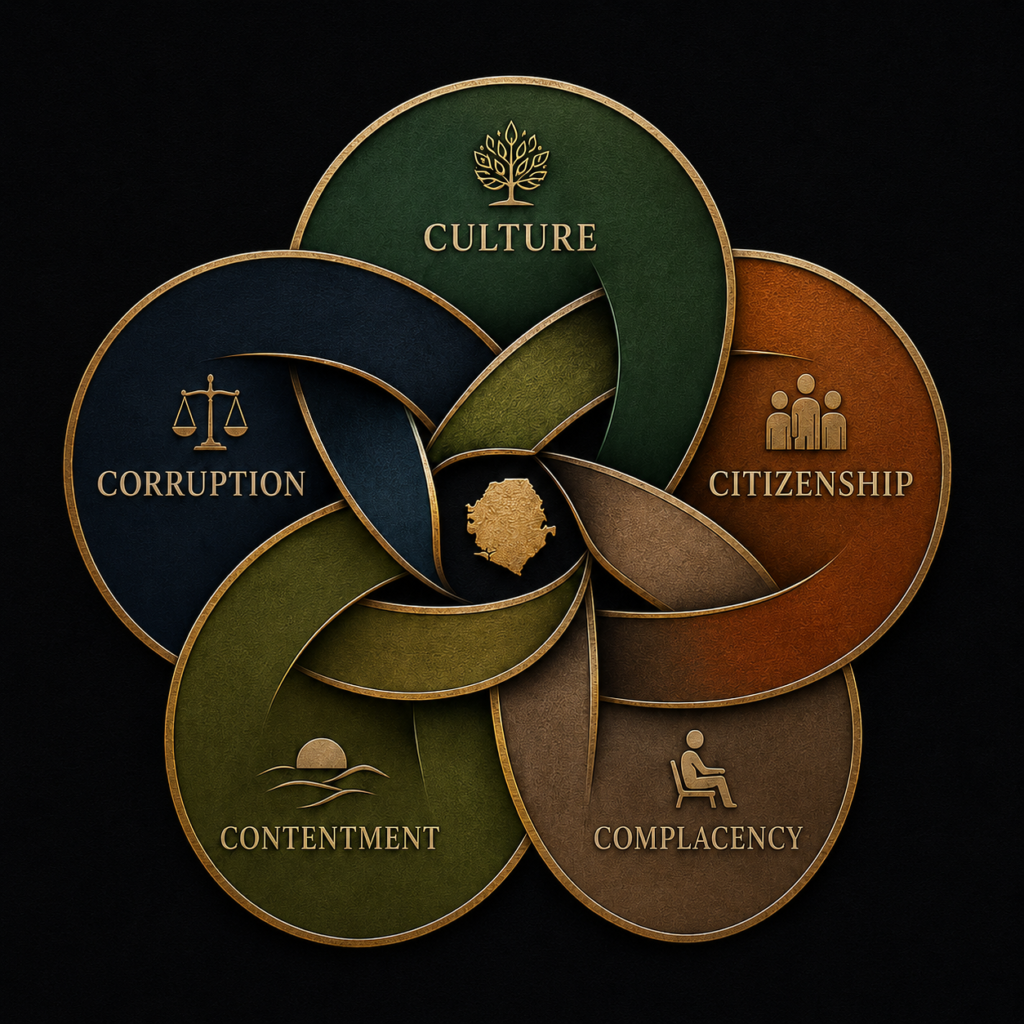
The 5C theory, developed by Bhai-Dhawa Sesay, examines the distance between recognising a problem and transforming the system that sustains it.
It begins with culture, the stories, loyalties, expectations and unwritten rules through which a society understands itself.
Culture gives us identity and belonging.
But it also influences what we defend, what we question, and what we learn to accept.
Then comes corruption, the distortion of public trust for private advantage.
Corruption is more than money changing hands.
It appears whenever institutions, authority and opportunity are diverted from their intended public purpose.
At the centre is citizenship, the relationship between the individual and the common good.
Citizenship asks whether we see public life as something done to us or as something we help shape through responsibility,
participation and collective action.
Then there is contentment.
Contentment can protect dignity.
It can sustain gratitude, patience, and resilience during difficult times.
But when contentment asks nothing of injustice, endurance can slowly become accommodation.
Finally, there is complacency, the stillness that develops when repeated disappointment lowers expectations.
What once caused outrage becomes familiar.
What becomes familiar begins to feel normal.
And what feels normal becomes difficult to challenge.
The five Cs do not operate separately.
Culture can make corruption appear ordinary.
Corruption can convince citizens that participation does not matter.
Contentment can help people endure.
Complacency can make that endurance permanent.
But these forces are not destiny.
When citizenship becomes informed, active and responsible, the direction of the system can begin to change.
The 5C theory is not a judgement against Sierra Leone or its people.
It is a framework for examining the forces shaping society and our own position within them.
Sierra Leone is the starting point.
But the larger question belongs to every society struggling to turn public awareness into public change.
This is an invitation to read, watch, listen, question and participate.
To look beyond individual events, to recognise the relationships beneath them.
And to understand that lasting change requires more than outrage.
It requires citizenship.
Knowing is not enough.
Change begins when recognition becomes responsibility in our society.
Trust and accuracy
Corrections and current version
No verified corrections are recorded for this episode.